

In the first two installments of this “state of AI” series, I reviewed the pace of change and the factors driving that change. Today’s installment reviews AI’s present-day impact.
In the first two installments of this “state of AI” series, I reviewed the pace of progress and the factors driving that progress. Today, I’ll explore the impact of these advancing capabilities, which can be summarized as follows:
AI has had, with a few exceptions, very little clear impact on the world at large.
Strap in! That may be about to change.
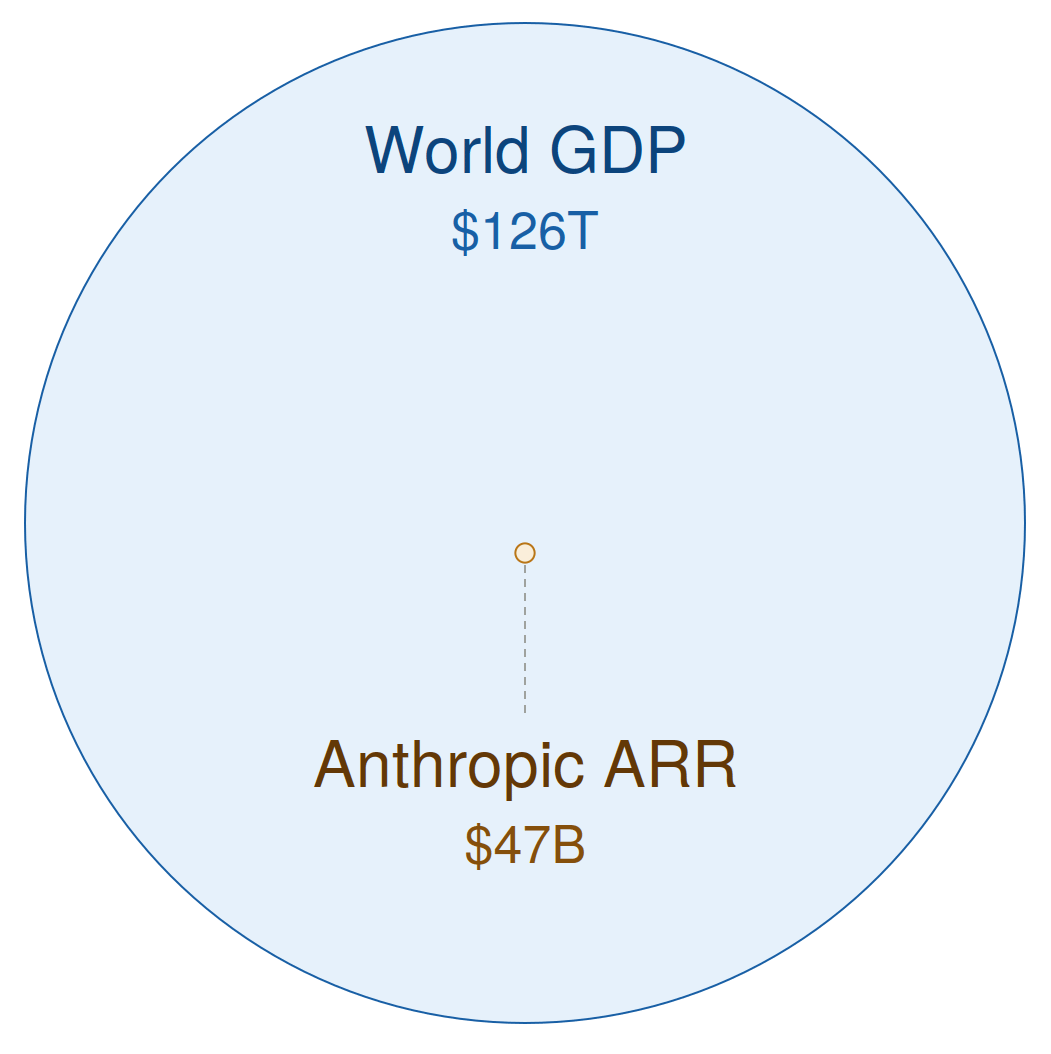
The meteoric rise of Anthropic’s sales figures nicely illustrate both points. The most recent report puts Anthropic’s revenue at a minuscule 0.037% of the global economy1. However, that 0.037% hides astonishing growth: from $1B at the beginning of last year to $47B ARR recently2. Continued growth at that rate would result in Anthropic subsuming the entire world GDP by the end of 2029. Obviously that’s not going to happen, but it highlights that AI is now at the threshold of global importance.
People in San Francisco like to compare the state of AI today to Covid in early 2020. It’s not yet having a visible impact in most places, but you know it’s coming. The analogy is good, but not perfect: predicting the course of a profoundly novel technology is harder than predicting the course of a respiratory disease (itself no easy task!). We can see that AI is poised for major impact, but despite various confident pronouncements, it’s hard to discern exactly how quickly that impact will unfold and what form it will take.
Why It’s Hard To Discern AI’s Impact
There is an overabundance of anecdotes and statistics, but the statistics mostly don’t mean much. For instance, “Business survey data from the Census Bureau show that about 18 percent of firms have adopted AI as of year-end 2025”, which tells us exactly nothing3.
The real questions don’t have clear answers yet. Is AI increasing productivity? Taking jobs? Improving access to medical information? Hurting people by providing inaccurate medical information? With few exceptions, the effects are not (yet) large enough to stand out unambiguously in hard data. Measures of the overall economy are buffeted by things like the Iran war, ongoing ripple effects from Covid lockdowns, or the changes in education policy behind the Mississippi Miracle. Amidst the noise, it’s difficult to assess whether any particular trend is being driven by AI. As I was completing this draft, the NY Times published an article titled A.I. Is Reshaping the Economy. Good Luck Measuring How:
A.I. might be contributing to the U.S. inflation problem, or part of the solution to it. It might be responsible for a recent pickup in productivity growth, or might be playing virtually no role — or the productivity boom itself might be a mirage.
The following graph illustrates the situation. It shows questions asked per month on the programming Q&A site Stack Overflow (source):
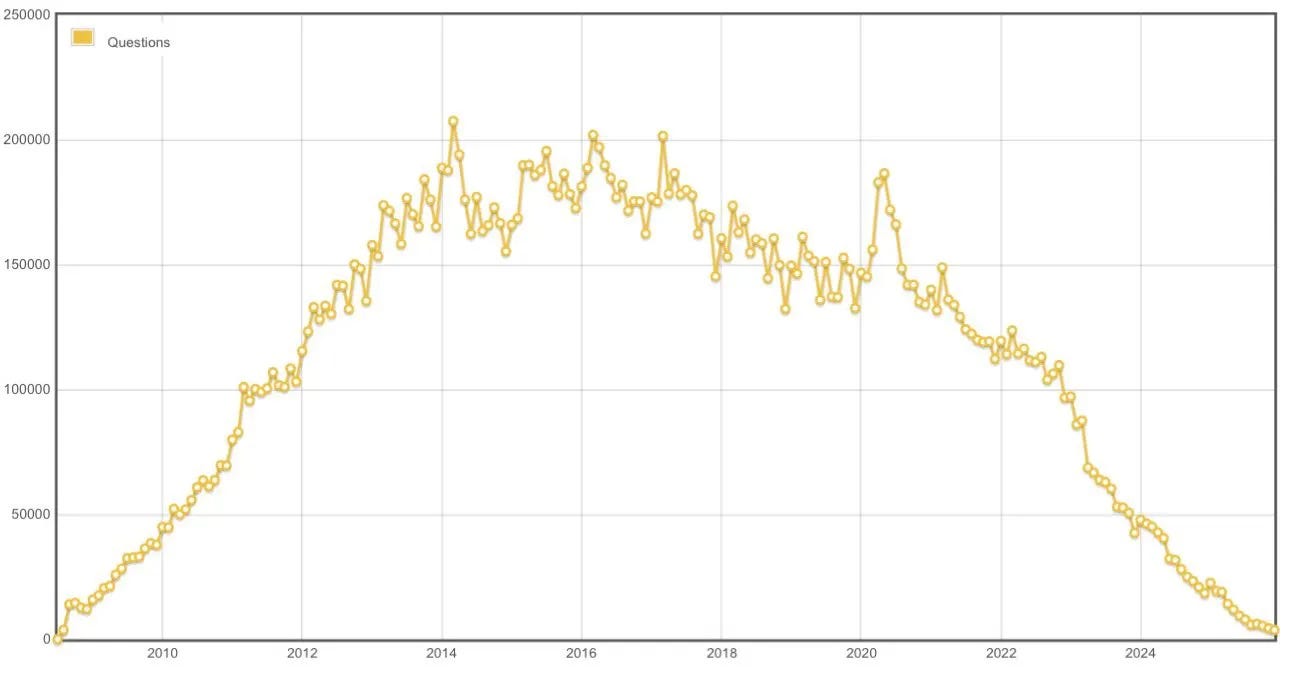
AI is undoubtedly contributing to the decline in usage, but the site has been in decline for over a decade, suffering from problems that predate the chatbot era.
It doesn’t help that AI’s impacts are highly uneven. Dramatic stories are everywhere, but it’s difficult to know how broadly representative they are. A New York Times reporter just saved $36,000 in fees by selling his house using Gemini instead of a realtor4; is that a sign that real-estate agents should start looking for new work, or a one-off from someone who is “paid to be an expert on A.I”?
Whatever AI’s importance today, it is undeniably growing rapidly. Some effects have become unmistakable, and that list will grow with each passing year. The exponential growth is ferocious, driving and driven by global AI capacity – which is increasing at roughly 10x / year5. At that pace, it doesn’t take long for a ripple to become a tsunami. Let’s start by examining the sector in which the first tsunami has emerged.
If you build it, you will spend a lot of money building it
The most obvious economic impact of AI so far has nothing to do with how people use it. It’s the titanic quantities of cash spent building data centers, filling them with chips, and providing them with electricity. One result is that Nvidia has risen from the pack to become the world’s most valuable firm – valued more than Walmart, Visa, Mastercard, American Express, Bank of America, Intel, Coca-Cola, Pepsi, Toyota, McDonald’s, Disney, and Chevron combined6. As Anton Leicht recently observed, this is “shaping up to be the largest infrastructure push in human history”:

And yes, this graph is adjusted for inflation. (Though as a percentage of GDP, the railroads are still champs, holy cow. One gets the impression that the entire US spent the 1880s laying track or growing food for people who were laying track.)
If you want to find a concrete impact from AI, look no further. A federal report estimates that “[AI-related investment7] contributed 0.97 percentage points to real GDP growth in the first three quarters of 2025” – roughly speaking, this says that the increase in AI investment was on pace to equal 1% of the entire US economy in 2025 (though see the footnote for some important caveats). Not “AI investment was 1% of the economy”, but “the year-over-year increase in AI investment was 1% of the economy”. A typical growth rate for the entire economy is 2.5% per year, so 1% is a huge contribution. AI investment is now a primary driver of US economic growth, to the point where it may be crowding out investment in other areas.
Construction workers and Nvidia stockholders aside, is the actual usage of AI affecting the economy? Some economists are speculating that AI might have added as much as one or two percent to labor productivity in 2025, which would be big if true: 2% is a year’s worth of progress. However, it’s an outlier view8.
These are all U.S. figures. AI investment in the rest of the world is much more modest, but there are some hot spots, such as Taiwan and South Korea (both of which are major chip manufacturers).
If AI is contributing to economic growth (at least in the US and a few other countries), what is it doing to the job market?
Labor market impacts: I did warn you that it’s hard to tell
The US unemployment rate has been drifting up for the last few years, but only modestly:

The upward trend starts around the time ChatGPT was launched, but that could easily be coincidence9; I can think of a few other things that might also have played a role. Are tech layoffs due to AI, or a hangover from excessive tech hiring during the Covid lockdown? Is reduced hiring of young workers in white-collar jobs due to AI, or is it because work-from-home could make it harder to train and supervise junior staff?
One study finds that employment has been reduced by a whopping 16 percent10 for “early-career workers in the most AI-exposed occupations”. That’s a narrow group (about 7% of workers studied), and no broad impact on employment is visible, even for software engineers11. Apparently “the age 20-24 unemployment rate is now ~unchanged since the AI boom began”12.
The upshot is that, while I read a lot about the impact of AI on jobs, I don’t have a clear idea what that impact is today. I am certain that, over time, there will be enormous changes in the jobs available. I would guess that overall employment is likely to decrease. It’s possible that this is already occurring, and if so, it’s probably hitting entry-level positions first. (As noted in the previous paragraph, we have clear evidence of that for “the most AI-exposed occupations”.) But we don’t seem to have a clear signal of impact on overall employment, which means the impact cannot be very large – so far. (There does seem to be a visible impact on some occupations, such as translation, freelance writing, and stock illustration, but even here it is not easy to find robust measurements of a dramatic impact.)
AI affects workers in other ways. Applicants are using AI to mass-produce cover letters; hiring managers are using AI to screen resumes. The net effect is to make the process of getting a job even more miserable, especially for people who don’t have a network that can help them bypass that initial screen. Meanwhile, AI systems are increasingly used to monitor and manage workers, giving rise to terms such as “emotional surveillance“.
Of course, before you’re a worker, you’re a student. And AI is changing life for both students and teachers.
Education
If you want to use AI to learn, it is the best tool ever invented for learning.
If you want to use AI to not learn, it is the best tool ever invented for that too.
More attention is paid to the detrimental effects of AI on education. AI can do most take-home assignments, and reports of students using AI to cheat are rampant. Many doctoral dissertations contain some AI-generated text. AI is being blamed for students losing math skills and failing classes, and while it’s always difficult to know how much of this is due to AI13, AI probably is having a negative impact on education today.
And yet, when used appropriately, it really can be a wonderful tool for learning. Anecdotally, it can be used as a tutor, to check your understanding of a new paper, or to create practice problems tuned to a student’s areas for growth. In one randomized trial, students given ChatGPT for a “study aid” (and provided with no guidance as to how to best use it) scored significantly lower on a retention test. But a trial in Nigeria, which involved virtual tutoring rather than unstructured access to ChatGPT, found substantial gains after just six weeks of after-school use. And that was using the now-ancient GPT-414.

Teachers are also using AI – some to help with busywork, some to create lesson plans or write “personalized” feedback on papers. As with students, AI usage by teachers can likely have both positive and negative effects, and identifying and encouraging the beneficial uses will not be easy.
Another important thing to think about: as AI changes the way we work and live, it changes what students should learn. We teach children arithmetic, but we also teach them to use calculators. AI is a far more profound tool than a calculator, and ultimately will require us to rethink education.
Next up, let’s examine the impact of AI’s physical manifestation – data centers.
Impacts from data centers

In the US, data centers have become one of the most controversial manifestations of the AI boom, possibly generating more headlines than the impact on jobs or education. Various local and even state bills would restrict or ban construction.
Opponents cite a variety of issues. Some are often overblown; in particular, concerns over water usage are, in most cases, significantly overstated (and get much more attention than other major water users). Others concerns have validity. The mad scramble to draw fresh gigawatts of power from the sclerotic US electrical grid is resulting in rising electricity prices in some places (though most rate hikes are unrelated and there is an argument that data centers can actually lower prices for other users). Elsewhere, “temporary” gas or diesel generators are generating egregious levels of air and noise pollution.
Some of the opposition to data center construction seems to be driven by concern regarding AI in general. Data centers are AI’s most visible physical manifestation, and blocking construction is the most obvious means of resistance. However, data center bans seem likely to simply push construction into other jurisdictions – possibly outside the US entirely and into less friendly countries. This is unfortunate, because done right, data centers have the potential to actually lower electricity rates15, create jobs, and provide tax revenue.
AI seems to be touching almost every aspect of society. Here are quick takes on some areas I haven’t covered yet.
Everything Else
I can’t possibly do justice to the full range of impacts from AI. Here’s a quick survey of some of the more interesting or important areas. Most of the available statistics are of the “18 percent of firms have adopted AI” flavor, i.e. useless, so what you’re getting here are simply my impressions.
General productivity: people are finding thousands of ways to use AI at work and at home. Summarizing a boring report, finding bad clauses in an apartment lease, filling out forms, planning a trip, brainstorming. A lot of this is dumb little stuff, like an occasion last month when I emailed six people to ask about their schedules and then I dumped their replies into ChatGPT to find a time when everyone could meet, saving me 5 tedious minutes of cross-referencing. But that dumb little stuff can really add up, and the tide is rising rapidly – even six months ago I probably wouldn’t have trusted ChatGPT to get the schedule question right. A recent study in Pakistan found that “Judges using AI clear 6% more cases, quality looks a bit higher (fewer appeals, better writing”16.

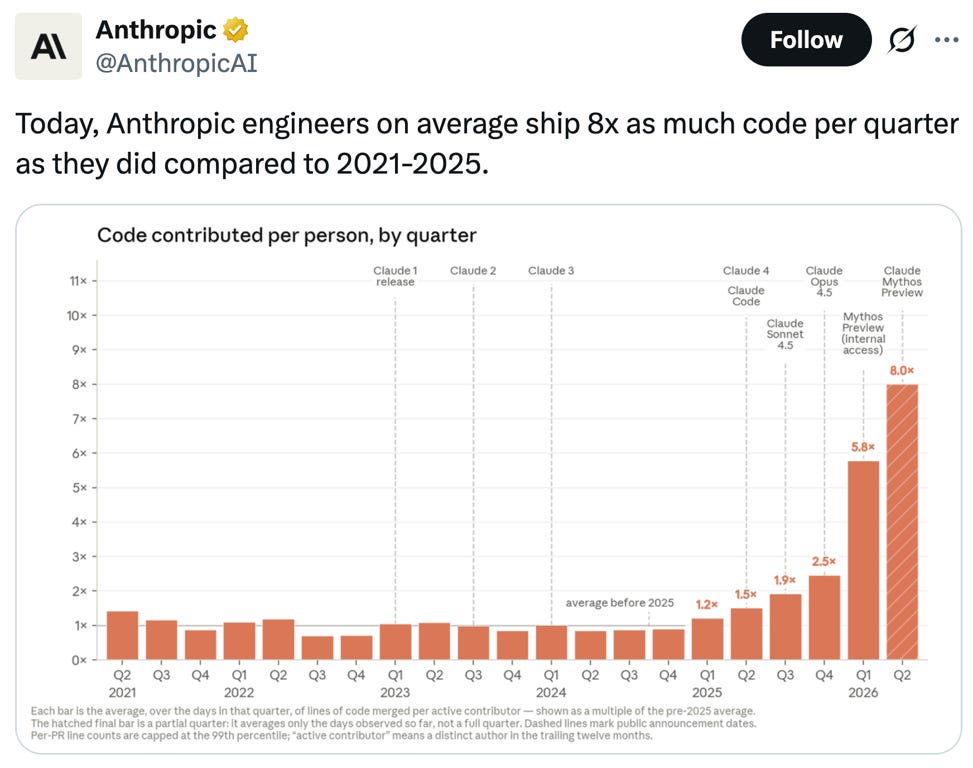
Software development: I’ve written extensively about the impact of AI on software development, so I’ll be brief here. Current AI tools can provide a huge productivity boost for coding, but the results vary dramatically according to how the tools are used and the kind of work being done. The overall business impact is generally much less, but some organizations do seem to be cracking the code on this.
Health care: the biggest impact so far has been individuals using chatbots to get information and medical advice. The help you can get from a chatbot is almost certainly still less useful than focused attention from a doctor, but it’s often much better than the actual alternatives – waiting days or weeks for an appointment, a quick call with an overworked advice nurse, or random Google search results.
AI is especially helpful for questions that no single expert would be able to answer. My go-to example comes from my friend Nathan Labenz, who had to bring his immunosuppressed, cancer-survivor young son home to a house that had recently experienced basement flooding and was likely infested with mold. He consulted with the “pro” tier of all three leading chatbots to examine both the medical literature and information on mold remediation to determine what level of air filtration and other measures would be enough to keep his boy safe.
An under-appreciated use of AI is to reduce the many hours per day that medical professionals spend on paperwork; often known as “pajama time” because clinicians have to catch up on this work at home. Doctors are also increasingly using AI tools such as OpenEvidence to research symptoms and answer questions.
There is much talk of using AI to automate medical billing and advance the billing-code arms race between providers and insurance companies – jobs which employ close to half a million people in the US alone. It’s not clear to me how quickly this is translating into reality.
Medical science: there are a bewildering range of applications of AI in scientific research and pharmaceutical development. Specialized models like AlphaFold predict molecular structures and help design novel drugs; agents powered by models like Gemini, [Chat]GPT, and Claude help with everything from literature review to filling out FDA paperwork. We are currently seeing a wave of new treatments, from GLP-1 drugs to novel cancer treatments… but so far they’re mostly not driven by AI. The pipeline from basic research to clinical application can take decades. The headlines are full of medical advances, but I’m not sure AI deserves much credit yet17. And meanwhile, AI “slop” papers may be overloading the overall system of scientific publication.

Mental health: Oy. AI has, reportedly, provided relationship advice; supplanted relationships by acting as a boyfriend / girlfriend / best friend; prompted users to reach seek professional help; been implicated in teen suicides; helped people think through major life decisions; led users into “AI psychosis”. Chatbots can be a companion, a coach, a sycophant, a crutch, or a cheap substitute for human relationships.
The situation is analogous to education: used wisely, AI can be beneficial to mental health, but I suspect that, like social media, it is mostly not being used wisely. And while I hold out some hope that we can find our way through AI and education, I’m less optimistic about mental health... and that’s without even mentioning the use of deepfake nudes for cyberbullying. Still, the potential for constructive usage is there, and the jury is very much still out.
Cybersecurity: AI is raising the temperature, with increasing use by both attackers and defenders. I’m not aware that it has drastically changed the practical equilibrium, but this could easily change over the next year or two; there are already reports of attacks being carried out autonomously by AI. It’s difficult to guess whether the overall effect will be positive or negative, but I lean “negative” in the near term, and I expect we will see some high-profile incidents enabled by AI.
War: Militaries are using AI to help process satellite photos, select targets, and guide drones. Reportedly, AI support substantially accelerated the targeting cycle for US strikes in Iran. One particularly striking report claims that “for the first time in the [Ukraine] war, an enemy position was captured entirely by ground robotic systems and drones” – though it does not indicate any use of AI (the robots and drones were likely being controlled remotely). Unsurprisingly, this is an area where it’s especially difficult to get solid data.
Politics: AI will affect politics as both an issue voters care about, and a tool for use by campaigns and advocacy groups. I’ll discuss AI-as-an-issue in the next installment. As a tool, AI has not yet had much visible impact. There have been a few instances where misinformation and deepfakes may have nudged the outcome of a race, but predictions that deepfakes would have an enormous impact do not seem to have borne out so far. This is probably because we’ve all been inoculated by repeated exposure to artisanal, human-authored fake news. And political operations have started making internal use of AI, but this also does not yet seem to be transformational.
One worrisome sign is the use of AI to flood channels for public comment. This does not yet seem to be widespread either, but it’s yet another reason why we can’t have nice things.
Substituting for other information sources: AI tools are replacing web pages and even how-to books as a source of information. This is honestly a huge boon for users, as chatbots are able to provide tailored advice and answer followup questions. However, it is also impacting livelihoods and damaging the economic incentives for publishing useful information18.
Helping blind people: AI is so useful for everyday tasks, such as reading food labels, that it is slashing the need for human volunteers on the “Be My Eyes” assistance app.
Robots: There is an enormous amount of effort being poured into AI-enabled robotics; endless billions of dollars have been invested into hundreds, if not thousands, of startups. However, not much has come of it yet. Robots have long played an important role in manufacturing; drones are now an extremely important factor in warfare; but these are mostly “old-fashioned” robots, following pre-programmed patterns or (in the case of drones) controlled by a human pilot. That may change rapidly in some sectors, such as the Ukraine war, but general-purpose robots aren’t here yet.
Wrapping up
Anecdotes and factoids about AI’s impact are everywhere. Unambiguous evidence of that impact is still hard to come by. That absence of evidence is suggestive evidence of absence: AI is still, for the most part, not a primary factor driving most trends in society and the economy. (Or at least, it wasn’t as of 6-12 months ago; it takes a while for evidence to work its way through the system.)
So, AI usage (as opposed to investment) is still not that big of a deal in most sectors of the broader world. But 2026 may be the last year in which that will be true. As I noted at the beginning, a broad range of AI metrics are growing rapidly, with many important measures increasing at 3x to 10x per year. Exponential growth builds rapidly; when the growth rate is 3x/year – to say nothing of 10x! – it builds very rapidly. We’re seeing early signs that the train is approaching; blink, and it will be here. From the New York Times article I cited earlier:
By the time the data is clear, [economists] warn, it could be too late for policymakers to figure out how to respond.
We need to invest in better and faster data collection, and the organizational capacity to respond quickly to that data. But those are topics for another post.
Lots of people provided suggestions and feedback for this series! Thanks to Abi Olvera, Alex Booker, Clara Collier, Dave Kasten, Eli Pariser, Emma Kumleben, Gideon Lichfield, Helen Toner, James Cham, Kai Williams, Meghan Apfelbaum, Taren Stinebrickner-Kauffman, and Tim Schnabel. Apologies if I missed anyone!
Roughly $47B ARR for Anthropic vs. $126T for the global economy. Though this comparison inflates Anthropic’s importance: corporate revenue reflects all money passing through the company; only the portion of that revenue that reflects value being created should be compared to GDP.
While I was working on this draft, a new report put Anthropic’s ARR at $60B.
Apparently, this means that 18% of companies responded to recent Census Bureau surveys by checking a box asking whether they use AI “in any of [their] business functions”. That could mean anything from using an A/B testing tool to tweak ad copy, to replacing the entire workforce.
Though it’s possible that a human agent would have gotten him a better selling price.
Epoch reports that available computing capacity is growing 3.4x / year, and also that the algorithms for making use of this capacity are becoming 3x more efficient each year. (3x is the figure reported for “pre-training”; I’m making the rough assumption that inference – usage of AIs once training is complete – becomes more efficient at roughly the same pace as pre-training.)
The harder I dug into exactly how this is measured, the more confused and unimpressed I got. Apparently, the 0.97% figure was obtained by:
Adding up spending on “Information-processing equipment”, “Software”, “Research and development”, and “Data-center construction”.
Comparing the total to the corresponding figures in the previous year.
The difference came to 0.97%. Well, not really; ChatGPT explains that “these are averages of the annualized quarterly contributions during the first three quarters, not a cumulative nine-month growth figure”. I decided not to go down that particular rabbit hole.
I was startled to learn that this covers all spending in these categories, not just AI-related spending. For instance, if McDonald’s spent money in 2025 to develop a faster way to cook french fries, that would be counted in the “research and development” category. If a retail store invested in a new inventory-tracking app, that would be counted under “software”. So the only way the 0.97% figure makes sense as an estimate of AI’s contribution to GDP growth is if you assume non-AI-related spending in these categories was flat from 2024 to 2025. Quite an assumption!
My favorite line from a Claude summary of a recent paper assessing AI’s impact on productivity: “On evidence strength, the paper is methodologically self-aware to the point of anxiety, and rightly so”.
Indeed, one of the key studies finds that the 2022–2023 decline that visually coincides with ChatGPT’s launch is likely driven in part by factors other than AI.
More precisely, the study found that employment for this group was 16% lower than workers of similar ages in less-exposed jobs, after controlling for certain other factors. Absolute employment in this group dropped by less than 10%, but that needs to be compared against rising employment in other groups.
For another data point, Arvind Narayanan of Princeton states that “the best data suggests that software engineer employment in the U.S. is still growing, though slightly more slowly compared to a no-AI counterfactual world”.
Though this could mean that the unemployment rate would have declined were it not for AI.
One comment on the linked article suggests changes in university admissions policies as an alternative explanation.
This is a paywalled link; here’s the key quote:
“Many hours of the day or times of the year, you have a lot of spare capacity on the grid,” said Ryan Hledik, a principal for the consultancy Brattle Group. “If you can get new customers or new electricity consumption added to the grid when and where there is that spare capacity — you could spread the cost of the grid across more customers and bring rates down.”
Derek Thompson lists the role of AI in all this as one of the topics for a recent episode of his podcast, but I haven’t listened to it.
Thanks to Abi Olvera for pointing out that while AI is impacting ad revenues, it is not necessarily impacting subscription revenues, and some subscription-based models (such as Substack) are in fact on the rise.
Great article, but the headline, "Anecdotes Everywhere, Evidence Almost Nowhere" is slightly flawed. Anecdotes are evidence, and they are particularly important in situations like this, where there is rapid change. You've correctly made the point at the end of the post that we can't wait for the evidence to be clear.
The Covid comparison is good in this regards. My background is in risk, and I found the "no evidence" mindset that was so common in the public discourse to be extremely stupid. I know you're not actually making that mistake; I just want to push back on the normalisation of the idea that anecdotes aren't evidence.
"The US unemployment rate has been drifting up for the last few years, but only modestly."
Any look at broad AI impacts on US employment might potentially benefit from taking into account the US labor participation rate, which has dropped from around 67% at the cusp of the 2020 pandemic to around 62% today. That's due to a variety of factors, including net retirement and more workers on disability:
https://fred.stlouisfed.org/series/CIVPART
The top-line US employment rate metric, U-3 – the rate that's recently been in the 4%+ range – uses the labor force as its base. If jobless people stop actively searching for work, for any reason, they leave the labor force. This drops the participation rate and shrinks the U-3 denominator. That paradoxically makes the unemployment rate lower (and hence look 'better'), because some workers have temporarily or permanently left the labor force and are no longer counted as "unemployed."
For that reason, it may be worth looking at the U-6 Total Unemployed Rate as an additional, broader measure of US employment trends that might also potentially surface some AI impacts.
Like U-3, the U-6 rate includes standard unemployed workers, but it also adds in "marginally attached workers." Those are people who want to work, but haven't looked for a job within the past four weeks: whether out of despair at finding work (on the part of "discouraged workers") or due to life circumstances like schooling, health, or family responsibilities. As well, U-6 also adds in "people working part-time for economic reasons (those who want full-time work but accept part-time hours due to slack business or cutbacks)":
https://fred.stlouisfed.org/series/U6RATE
The U-6 rate drifted up from 6.7% to 8.7% during the period from around mid-2023 to late 2025, until – after a stats discontinuity break due to a government shutdown – it's since fallen in recent months. That may or may not in part reflect AI-related impacts, yet it does paint a somewhat different picture than U-3, which moved from 3.5% to 4.4% over that same recent 1-1/2 year period.
There's a FRED page listing U-3, U-6, and other "alternative methods of labor underutilization." That page also offers a feature for generating custom graphs:
https://fred.stlouisfed.org/release/tables?eid=4773&rid=50