

The Golden Gate Institute for AI is hiring!
As AI increases in salience and pace, demand for our events and programs has grown enormously, from The Curve to small targeted events. To meet the moment, we’re expanding our team by 50% in the next few months. This is an opportunity to have a big impact, so please spread the word to your friends who you think would be great additions to the work – or apply yourself! We’re looking for:
A very senior leader in the form of either a Chief Program Officer or a Managing Director
All four positions are listed at goldengateinstitute.org/careers/substack.
And now on to our regularly scheduled programming…

I now think that we are more than 50% likely to have full blown superintelligence in the next 18 months, absent a slowdown. I need to call my family.
“There’s material risk of AI takeover in the next 6-12 months... For most people in this room, the most likely reason they will die is because of an AI accident.”
Sentiments like the above are proliferating. The trigger is a recent report from METR suggesting that, primarily due to internal use of AI, the pace of progress at Anthropic has roughly doubled over the last year1. The report also states, “We did not identify any convincing bottlenecks to continued rapid progress2.” This is being taken as evidence of the early onset of a self-accelerating RSI3 feedback loop.
Friends and colleagues are asking whether they should be worried. They know me as a supplier of calming takes, always ready to cast doubt on the most aggressive AI forecasts. But my confidence has been wavering of late: a lot of very smart people are joining the short-timeline chorus, and some of them have inside information. What if they’re right?
The final goalpost
There is debate as to whether AI is a truly transformative technology. But “full blown superintelligence”, if and when it arrives, will be a Very Big Deal.
There’s no precise definition, but in general, when people talk about full-blown superintelligence, they mean something that is better than all people at more or less everything. That means better physics intuition than Einstein. Better negotiation skills than Kissinger. Something that can conduct better interviews than Oprah, make better investment decisions than Warren Buffett, devise cleverer plots than Agatha Christie, have better product taste than Steve Jobs, and implement those products more cleverly than Steve Wozniak.
It is debated whether AI will ever be able to do all that. But as I understand it, this is what people sounding the alarm about RSI are expecting. And without getting into questions about what sort of world would ensue, I claim that the stakes would be very high. Full-blown superintelligence would not be a tool we harness. It would be a tiger we’d have to ride. It would not be a “normal technology4”, because many of the barriers to adoption would melt away. Businesses would not need time to adapt to it, because it would adapt to them5 – a true drop-in replacement for human workers, with a side order of superhuman speed, competence, and stamina. It would not need to be trained on years of deployment data in order to learn a skill, because by definition it would already have all the skills6; also, it would likely be a quick study. It would be a world-bending technology, whether for good or ill (or both).
(I’m assuming that robots come along in here somewhere. We’re already making good progress on that front. A truly superintelligent AI would presumably finish the job within a few years.)
Of course, the impact could be blunted by regulation, social norms, and other non-technical barriers to adoption. But there will be strong economic and military incentives for adoption. A world with superintelligence would be a world experiencing profound change. For this reason, superintelligence is the “final goalpost”: if we reach it, the question of whether AI is a uniquely transformative technology will be settled once and for all.


That debate – is AI a transformative technology? – remains open, because while capabilities have been roaring ahead, broad impact has been hard to discern. For now, it is possible to reconcile this by arguing that the impact will come later. Superintelligence would eliminate that ambiguity, either by indeed transforming the world, or by revealing some barrier that increasing capabilities cannot overcome.
Now that we’ve established the stakes, I’m going to summarize the arguments on both sides of the question – is full-blown superintelligence imminent? I’ll start with the case for “no”.
The bear case
AI’s accomplishments are less than meets the eye
One explanation for the lack of hard evidence of broad impact from AI is that current capabilities are often less significant than they appear at first glance.
AI can produce flashy games and videos, lengthy reports, and thousand-page mathematical proofs at the push of a button. But the games and videos have a one-trick-pony feel; all of those Claude 5.5 animated videos seem to be basically the same – more of a party trick than a general capability. AI-generated reports look meticulous and polished, but often contain serious flaws or miss the point entirely. Similarly, scientific research produced by AIs often turns out to be flawed. And the headline results in mathematics are generally the result of grinding through a long series of calculations, building on human insights without adding any powerful new ideas. A result is a result, but these results may not presage the ability to carry mathematics forward to the next round of insights7.
In short, many of AI’s most startling accomplishments lose some of their oomph on closer inspection – possessing the surface trappings of impressive work, but missing important elements. Arguably, those missing elements reflect persistent weaknesses in AI cognition.
Progress in some fundamental capabilities seems slow
Even as AI models become ever more brilliant, they retain a certain stubborn cluelessness. They lack context, or they fail to assimilate the context they’ve been given. They hyper-fixate on unimportant details, they wander down blind alleys, they miss the point8.
Descriptions of the lagging capabilities tend to be frustratingly vague – AI is lacking in “judgement” or “research taste”, or struggles on “messy tasks”. As Internet denizen “Nostalgebraist” points out, there’s a reason we struggle to describe these shortcomings:
...since anything that can be formalized as an eval can be hill-climbed9, we are effectively experiencing an adversarial attack on our ability to notice and name gaps in model capabilities. Whatever can be easily described becomes grist for the optimizing mill; the gap, the part left over, is precisely that which we can feel but which we do not find it easy to describe.
Some people argue that these missing skills are advancing slowly (or not at all), and thus will continue to limit the impact of AI for years to come. Perhaps the most important lagging capability is “sample-efficient learning”: AIs need millions of data points to learn skills that a person can pick up relatively quickly. As a result, they may be fundamentally challenged in mastering tasks where data is difficult to come by.
The RSI feedback loop may not spill over into poorly-specified tasks
AI is not currently on pace to become superhuman, in the next year or two, at “messy” tasks such as managing a (non-AI) team, writing a novel, or running a large business. The case for near-term superintelligence rests on AIs becoming superhuman at training better AIs, and then applying that skill to accelerate progress on messy tasks far beyond the pace we humans have been able to achieve.
However, it’s not clear that this is feasible. If the current arc of AI progress is not yielding advances in messy tasks or sample-efficient learning, then RSI acceleration of that shallow arc may have limited impact. One tenet of the AI as Normal Technology thesis is that AI capabilities in many domains are bottlenecked on multiple rounds of iterative deployment of AI in those domains – deployments that proceed at the pace of business adoption, not GPU computation.
The math doesn’t add up
The idea that RSI won’t yield an accelerating feedback loop has some quantitative support. For instance, in Where’s the “intelligence explosion”?, Ramez Naam concludes that “given our best current data, the AI self-improvement loop would need to be roughly 5–10× stronger to sustain itself, let alone run away”. One bit of evidence: a report from OpenAI showed that compared to 2025, researchers have increased their token usage by 124x, but the number of experiments they’re able to run has increased only 1.6x.
(It’s worth noting that in my notes for this blog post, I’d flagged several other papers as also supplying analytical evidence against an intelligence explosion... but on closer inspection, the essay I linked above is the only one with a quantitative model that clearly points toward a near-term intelligence explosion being unlikely.)
Now let’s explore the opposing arguments.
The bull case
There are strong signs of acceleration
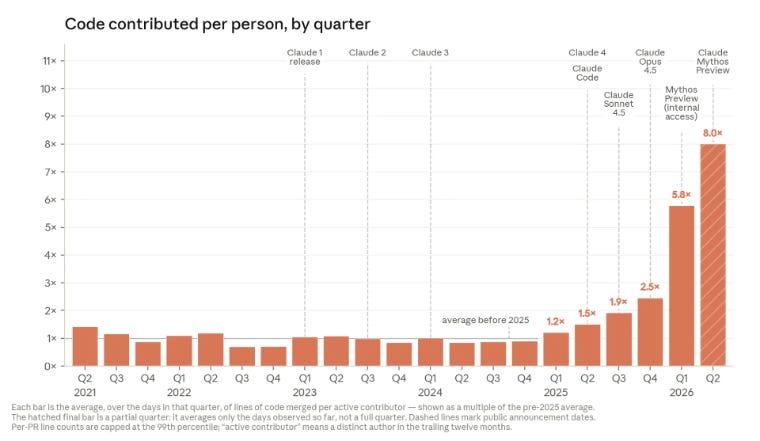
The doubled pace at Anthropic, documented in the recent METR report, is a massive accomplishment. A slightly older report from Anthropic, When AI Builds Itself, provides some relevant statistics. For instance:
As of May 2026, Claude was writing more than 80% of the code at Anthropic.
Also in Q2, code written per engineer had octupled from the 2024 baseline.
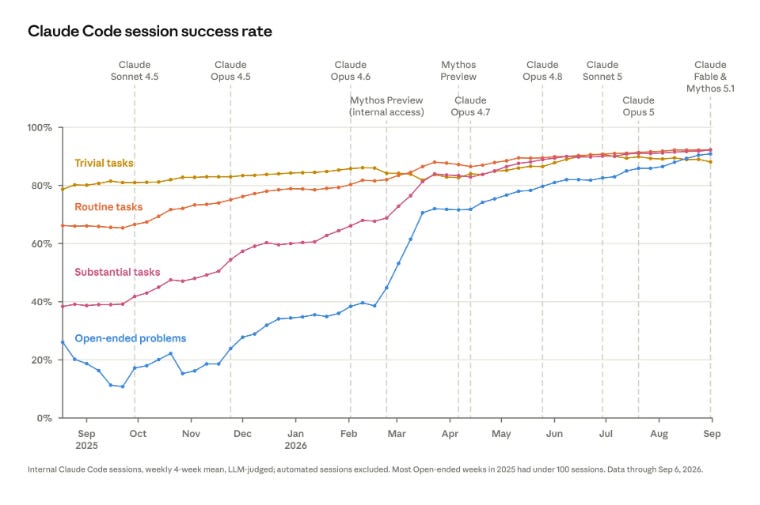
Claude is independently carrying out increasingly complex tasks (see the second graph below).
This data is from Q2, which is an eternity ago. In September, Anthropic added a brief update with the following graph, showing that Claude Code can now carry out most “open-ended problems” on its own (with important caveats10):
The last redoubts are starting to crumble
There is some suggestive evidence that AI is starting to progress on recalcitrant capabilities such as “research taste”:
The graph just above shows strong progress on Claude Code carrying out “open-ended problems11”.
The METR report indicated that Anthropic staff describe “signs of life for fully autonomous contributions in some parts of the pipeline”.
Noam Brown, a senior research scientist at OpenAI, reportedly has said that he wouldn’t be surprised if the models 1 or 2 releases from now have better research taste than him.
Quantitative support is provided by P-Zero Research, which reports that according to their “TasteVal” benchmark:
The experimental research taste of frontier models has doubled every ~3 months since December 2025. The best model, Opus 5.5, now exceeds our expert human baseline. Our human experts are experienced researchers, but most haven’t worked at a frontier lab. [emphasis added]
Maybe the math does add up
The folks at the AI Futures Project engage in extensive mathematical modeling – most famously, in their AI 2027 mega-essay. Their latest update, incorporating the recent METR results, says it all in the title: Looks Like the Intelligence Explosion Will Happen in 2027 After All.
(Similarly to my note for the bear case, many of the models I was planning to cite here as evidence for the bull case turned out to lack a clear claim regarding the prospects for a near-term intelligence explosion. It’s also worth noting that all of these models are highly uncertain, working from inadequate evidence. For instance, Basil Halperin notes that recent data can be reasonably interpreted as indicating that the scale of tasks AI is carrying out inside OpenAI is doubling every 68 days... or every 585 days.)
We are now well ahead of the AI 2027 timeline
The AI 2027 scenario was widely criticized for predicting unrealistically rapid progress. Well, we’re now five months ahead of that schedule! METR pegged RSI as having doubled Anthropic’s progress in October; in AI 2027, doubling happens around March 2027. This is the scenario that predicts the following for November 2027:
In its specialty of AI research, an individual copy of Agent-5 is twice as far beyond the best human genius, as the genius is beyond a typical [frontier lab] scientist. In other domains, it hasn’t been explicitly trained but can teach itself quickly to exceed top human experts from easily available materials if given the chance.
The forecasters behind AI 2027 have a remarkably good track record. “These guys have been right so far” is honestly a decent argument, even if it doesn’t directly address the potential difficulty of AI progressing in areas where it has historically struggled.
Have you not seen the signs and portents?
An AI has solved a Millennium Prize problem in mathematics – something done only once by an unassisted human. (Update: another Millennium Prize problem fell, this time to a human / AI collaboration, while I was drafting this!) AI is knocking down other problems so quickly that mathematicians are literally rethinking their careers. Coding agents can knock off major projects with minimal prompting. Laypeople are casually solving ancient ciphers. Cybersecurity is advancing so rapidly that the rush to apply patches may be causing headline-grabbing outages. And all of this has emerged just in the last year.
There is a reasonable argument to be made that we’re overthinking the question of whether these are signs of an approaching singularity. Like, what does a budding intelligence explosion look like, if not this? You might call it “the argument from are you fucking kidding me”.
The crux of the matter
These arguments can be frustratingly difficult to reconcile. For instance, “the rate of AI progress has doubled” is not a particularly direct rebuttal to “advancing AI capabilities are not having any visible impact on real-world metrics”.
However, I think there is a key question that runs through the debate: how much progress are we seeing on the things AI is bad at, such as “taste” and sample-efficient learning? I’ll present three scenarios. Each scenario can be depicted by graphing various capabilities over time:
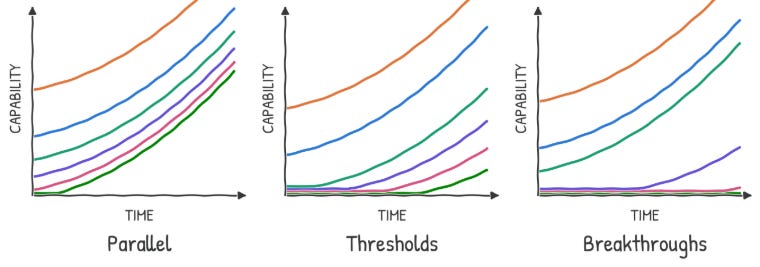
In the first, “Parallel” scenario, AI capabilities are uneven but advance steadily across the board. In the second, “Thresholds”, some capabilities can’t develop until AI reaches a certain level of sophistication, but then they progress smoothly, and there are no barriers to any particular capability emerging. In the final scenario, “Breakthroughs”, some capabilities will require fundamental breakthroughs that won’t automatically emerge from the current march of progress.
Each scenario has implications for RSI:
In the Parallel scenario, taste and judgement are already advancing (from a low base), so acceleration would cause them to advance rapidly. This supports the possibility of an intelligence explosion.
In the Thresholds scenario, an intelligence explosion might not take shape until some of the laggard capabilities start to advance.
In the Breakthroughs scenario, an intelligence explosion might not be possible until several breakthroughs have occurred, and AI won’t necessarily be of much help in creating those breakthroughs.
This points toward a key question for forecasting the impact of RSI: are there capabilities that current AIs lack, which hinder AI from driving the development of those same capabilities?
In a conversation with Zvi Mowshowitz at the recent Takeoff conference, I said that the key question is whether training AIs to get better at non-verifiable tasks is a verifiable task. That was overly glib, and Zvi argued that the answer is “yes”. This was approximately the thesis of Dwarkesh Patel’s recent post, The avalanche that hit math is coming for AI development. Zvi summarizes Dwarkesh’s argument as follows:
AI research is a lot like math in that you can do it by making number go up.
AIs are going to get very good at AI research.
We will then be able to make massive progress on AI research.
That will be good enough to make AIs better than us at everything else.
This is a plausible argument for sure, but it does not directly address the issue of non-verifiable tasks. Dwarkesh does address this, and again the arguments are plausible, but hand-wavy, and I’m not entirely convinced.
“Generating new insights” is an alternative candidate for a critical capability – one for which an AI lacking the capability will struggle to train an AI that has the capability. Generating insights seems to be a real weakness of current AIs, as evidenced by the fact that OpenAI models have solved hundreds of open problems in mathematics without (visibly) producing even a sliver of the insights that human mathematicians would have developed along the way. And it seems plausible that new insights will be needed to create an AI that can generate insights.
Said another way: the current wave of AI development was kicked off by the introduction of the “transformer” architecture for AI models. It’s possible that another breakthrough of that scale will be needed to create transformative AI. And it’s not clear that current AI systems are on track to produce such breakthroughs. But neither is it clear that they aren’t! In a recent post, Zvi directly addresses this type of argument:
There are various versions of ‘the AIs will need [X] and won’t have it’ as explanations for why all of this won’t happen. Those types of methods have predicted ~7 of the last zero times that AI has hit a wall and stopped advancing its capabilities. They have looked rather foolish. None of the remaining barriers seem different in kind to me than the barriers already overcome.
He has a point. But for every incorrect prediction that AI capabilities were about to hit a wall, there’s been an equally incorrect prediction that AI capabilities were about to unleash some large-scale impact on the world, such as disinformation or job loss. This is the point of the Alex Imas tweet I quoted earlier, and Sam Hammond’s framing of the current situation as a “build-up to a series finale”. We may finally be approaching the point where the answer to the question, “is AI a normal technology?”, can no longer remain ambiguous.
I would also note that while claims that AI is about to “hit a wall” have rarely aged well, the question is not whether AI is going to hit a wall. The question is where the current arc of progress leads; it could continue apace without leading directly to world transformation. There’s no graph whose Y axis has a threshold clearly labeled “superintelligence”.
How to tell which path we’re on
In a world with barriers to an intelligence explosion, I would expect a plot of AI capabilities to look more like the Breakthroughs graph above. In a world where there are no such barriers, I’d expect the Parallel graph.
To tell them apart, we need to measure progress on laggard capabilities. It’s clear that even the latest public models exhibit shortcomings in taste, judgement, sample-efficient learning, and general “cluefulness”. It’s much less clear how much progress is taking place to address those shortcomings.
Concretely, three things are urgently needed:
More information from frontier labs. OpenAI and Anthropic have both provided important information of late. Much more is needed – Anthropic redacted the majority of the evidence supporting METR’s bombshell report.
More studies of capabilities like taste and sample efficiency. Measuring these soft skills is difficult, requiring careful problem design and large compute budgets. Excellent work is being done; more is needed, requiring funding, talent, and access to unreleased models.
Pointed discussions as to exactly what evidence would support or undermine the case for short timelines. By clarifying the bull and bear cases, we can help direct information-gathering efforts.
Waiting with bated breath
It seems insane that we can’t state, with any confidence, whether or not an event as profound as an intelligence explosion is likely to occur in the next year or two. But here we are. I still don’t think it’s likely, but I’m no longer confident in ruling it out. And the odds that it might occur within five years – still a very short time! – seem not so low. Perhaps the simplest way of framing the question: is learning to do the things AI is bad at something AI can be good at?
(I think the most likely outcome is an intermediate scenario: AI will accelerate the rate at which human beings can generate new insights. The acceleration would come from eliminating grunt work, compensating for human weaknesses, and generating new visualizations, exploration tools, and other supports for human intuition. I expect this to eventually carry us over the threshold from which the machines can take over, though I’m very unsure of the timeline.)
I expect that the next few months will shed a lot of light. Of course, if RSI really is imminent, we don’t have months to spare. And given the stakes, even, say, a 5% chance of RSI next year would be a really big deal!
It’s worth noting that I’ve framed this post on the assumption that developments continue on their current course. Business as usual, if the term “usual” can be applied to anything happening nowadays. But business as usual is by no means assured. There are any number of ways in which progress might slow, such as a recession, a war (especially one that impacts the chip manufacturing hub in Taiwan), or a political backlash. Conversely, it’s possible that capabilities could leap forward at any moment, as the result of a breakthrough on the scale of the transformer architecture.
I still don’t expect a near-term intelligence explosion. But I’m less confident than I was, and the stakes are high. It’s imperative that we get a better view of what lies ahead.
The discussion doesn’t stand still. Here are three late-breaking posts that look very relevant, that haven’t had time to read:
A new METR report on AI capability measurement (direct link to the report)
The Most Important Charts in AI are Wrong (direct link to the full post)
Shortly after posting this, I’ll add a supplemental post with a few additional thoughts, and a collection of quotes and links to additional material that I found helpful in assessing the current state of affairs. I won’t be pushing that supplement to my subscribers, but I’ll add a link here; you’ll also be able to find it at secondthoughts.ai.
Specifically, this is based on a measure of “well-specified tasks”; the extent to which this constitutes evidence for accelerating progress overall is debated, as I’ll discuss.
Caveat: METR notes that their view of the bottlenecks “changed several times” during the assessment, and they are “not confident in our current assessment”.
Recursive Self-Improvement.
In AI as Normal Technology and subsequent publications, Arvind Narayanan and Sayash Kapoor cite various reasons that even highly advanced AI will not have the world-bending impact I’m gesturing at here. Some of their points stem from contemplating AI that falls short of full-blown superintelligence. Some relate to how they expect (or recommend) AI to be used in practice, rather than limitations on AI capabilities. I touch on some of those factors a few paragraphs down when I mention “non-technical barriers to adoption”. And for some domains, they argue that the inherent complexity of the world places a ceiling on intelligence, said ceiling potentially being at around top human level.
I am glossing over important considerations, such as the availability of enough computing capacity to meet demand for agents, and the time potential adopters would need to build trust in AI reliability. However, if true full-blown superintelligence does in fact emerge, I wouldn’t expect these factors to limit the impact for very long.
If you believe AI will never have “all the skills” until it has been trained on years of deployment data, then what you are saying is that broad superintelligence can’t arrive until that data has been collected. This is a reasonable belief! But a forecast of near-term broad superintelligence is a forecast that this belief is incorrect.
In addition to the link, see also this Twitter thread, where Tom Reed highlights “To what extent have the existing AI discoveries in maths started building off each other?” as a crux question. Paul Christiano, in his recent Dwarkesh interview, references the recent AI results in mathematics and says “we just got this incredible data point saying it is actually possible in one month to have a decade of progress”. But I don’t think this is the correct interpretation of what just happened; we’ve had a decade’s worth of proofs, but not a decade’s worth of new ideas and insights.
Tom Reed flags a nice example: “When asked to design an experiment using novel chess variants to measure OOD generalisation, all models use existing chess variants they claimed they’ve invented de novo. Hilariously, Argon [a recent AI model from Google] does this despite establishing that the models it’s testing already know the variants.”
In plain English: for any skill where performance can be graded numerically, it’s generally feasible to teach AI that skill through a series of incremental refinements. (At least, to the extent that the grading faithfully reflects the skill. In practice, the AI may wind up gaming the system, producing solutions that pass the grader but don’t properly manifest the desired skill.)
As Tom Reed puts it in The Goodhart Singularity: “I think it’s impossible to get good at solving problems without access to a source of those problems, and that arduous interaction with the real world in serial time is the only such source. I therefore believe that the development of domain-general superintelligence will depend on the laborious, painful and expensive deployment of AI into the real world.”
Note that success is scored by Claude, which may be overly generous. Also, this graph is evaluating sessions people chose to hand to Claude Code, so it’s likely skewed toward Claude-friendly tasks.
Defined as “problems with no clear specification, where the engineer isn’t sure what the answer looks like”.