

The course of AI is one of the most important questions of this moment in history. Many brilliant people are engaged on the topic. As stressful as the current situation is, there is a real joy in getting to participate in such an exhilarating discussion.
I drew extensively on that discussion in preparing my recent post, The Final Goalpost. The amount of material I left out greatly exceeds the amount I included. Here are a few additional thoughts, plus a big pile of links and quotes.
Thoughts on progress in laggard AI capabilities
The quantitative data used to forecast AI progress is sparse, with wide confidence intervals. This applies to the METR finding of 2x progress at Anthropic. Meanwhile, Yo Shavit observes that OpenAI’s data does not show much acceleration in capabilities progress. Nor, to my understanding, have estimates of time horizon doubling rates accelerated.
Studies like CRUX evaluation 2 often find that even the latest public models have great difficulty in carrying out research tasks. At the recent Takeoff conference, I heard at least two people argue that this is the result of insufficient budget (not allowing the model to think hard enough and/or use enough compute), and/or not doing a good enough job with the prompt and harness. It would be great to see this explored more definitively – but doing so is a big project!
One data point for AI models being bad at learning on the fly is Epoch AI’s EBR-bench. This project uses an AI model to play an obscure game, Earthborne Rangers, and measures how the model’s performance improves over time. The initial study, published in July, found “no improvement upon repeated play“:
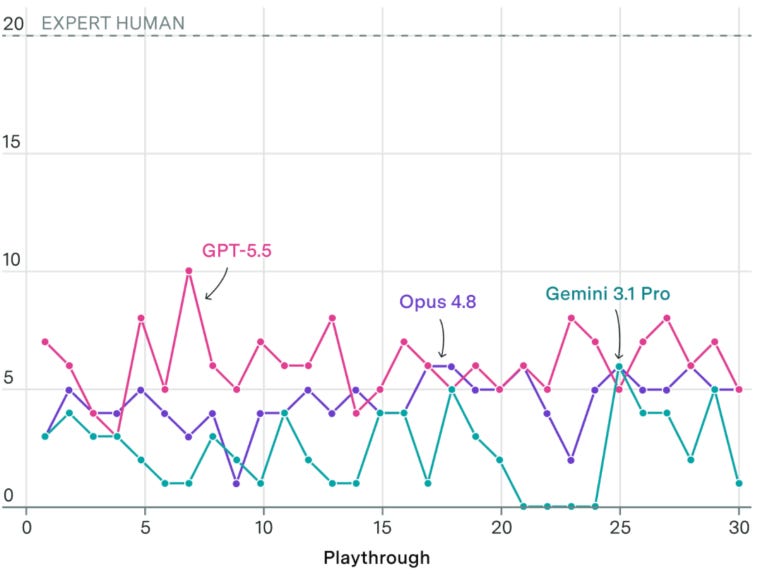
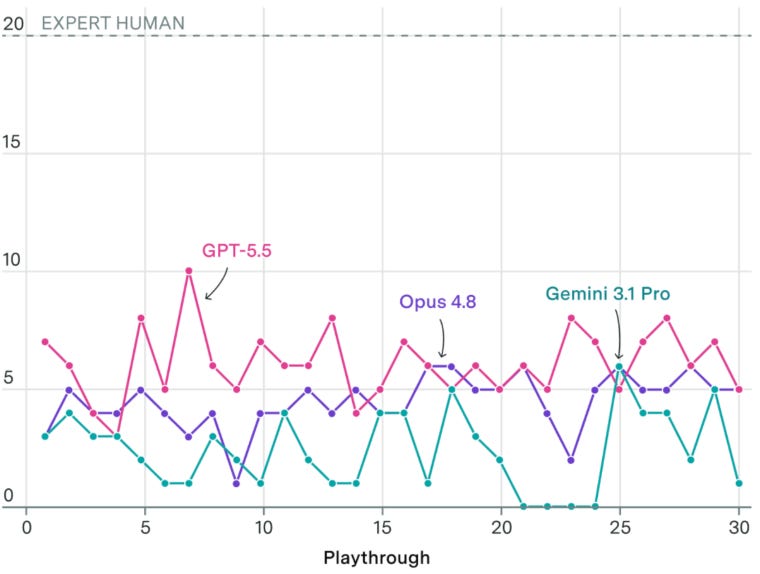
While researching this post, I was startled to see that the latest models from OpenAI, Anthropic, and Google all come very close to expert human performance! However, it appears that this does not reflect an improvement in the models’ ability to learn from repeated play; instead, they’re just getting smart enough to play well from their first game. (Which raises the question, can models just become smart enough to be able to do anything out of the box? I doubt it, but that’s a whole other can of worms and it’s conceivable I could be convinced otherwise!)
We’ve already had plenty of things that LLMs were notoriously bad at, until over a short period of time, they became very good at them. For instance: mathematics; computer use (automatically driving a keyboard and mouse to accomplish tasks on a computer). Conceivably, the same thing could happen with AI “research taste”.
More arguments that progress is slow in some important areas
From OpenAI’s latest report on research acceleration:
Workflows require close human involvement to avoid low-quality outputs and wasted cycles: agents struggled to launch experiments efficiently, rabbit-holed on unnecessary steps, wrote “AI slop” PRs, produced unusable data artifacts, and made invalid analysis assumptions.
Theo Jaffee identifies additional bearish data points in the latest OpenAI report; for instance:
Seems like the OpenAI research acceleration blogpost is not what you would expect if we were definitely on the cusp of artificial superintelligence... Agent workdays have grown very jaggedly, swarm sizes haven’t grown very much... There also hasn’t been an acceleration in research experiments per experimenter, or in the internal ECI scores of OpenAI’s models. Perhaps most importantly (and most surprisingly), the task success rate for <15 min tasks hasn’t grown very much at all...
InnovationEval (“so far, agents’ results are underwhelming”)
EurekaBench (“agents are still far from being scientists capable of advancing scientific discovery... the mechanisms they discover yield far fewer insights than those discovered by human scientists”)
CRUX (“poor judgment about the bar for publishable research, uncreative responses to shortcomings in the research design, ineffective backtracking from dead ends, poor resource awareness, and instruction drift”).
TasteVal indicates that “experimental research taste of frontier models has doubled every ~3 months since December 2025”, but Oliver Sourbut argues that the models are limited to assimilating and imitating taste from behind the frontier, which “goes stale” as the frontier advances.
Today’s LLM agents are so smart, in so many ways... and yet they constantly make fairly basic/dumb mistakes, in my experience.
This has been my experience with coding agents since day one, and does not seem to be improving.
I find AI to be extremely knowledgeable, and so exceptionally able to detect references to almost anything, but not very wise, and so it only makes the most surface-level judgements about what point some writing is making.
For AI R&D acceleration, I’d think about “optimizations” and “paradigm shifts”. For the former, math might be weak evidence, but we don’t need it: just track optimization benchmarks! I bet AI squeezes some real juice there. For the latter, math is, if anything, negative evidence.
A recent set of posts by @ramez on the current state of recursive self improvement highlighted that OpenAI’s report on their own research automation shows that models struggle to do their R&D work — the models’ 80% time horizon is only 15 minutes
I appreciate Anthropic’s transparency in sharing this chart but unsurprisingly it has led to speculative interpretations about intelligence explosion and superintelligence. I don’t think the chart implies we’re anywhere close to either.
In short, task delegation ≠ task automation ≠ process automation ≠ faster progress ≠ recursive self-improvement ≠ intelligence explosion.Also see this tweet
Everyone wants to know - are Anthropic’s models also improving faster on fuzzy tasks?
We don’t know, but tentative analysis from METR in the Mythos 5.2 system card suggests the new model is not obviously an improvement over 5.1 on open-ended tasks
Arguments that there are fundamental challenges to be overcome
Tom Reed presents two preconditions for “a secluded intelligence explosion” that are a challenge even for human researchers:
1. “sample efficiency” is indeed a coherent thing that can be maxxed from within the datacenter in a way that generalises to the real world.
2. It is possible to design a continual learning algorithm that generalises to the real world even when you can only test it out on synthetic environments. This might not need perfect sim2real - the AIs just need to create diverse and rich enough environments to find an algo that generalises. Humans are potentially a case-in-point here, given that our continual learning transfers from the African savannah to TSMC.Kevin Esvelt presents a long list of AI shortcomings, in support of the following thesis:
...any semantically open long-horizon domain looks like a wall. More precisely, a plateau near the level of human performance, because pretraining imitates it and RL only exceeds it when the answer can be verified.
I agree pretraining loss is a good proxy, but it measures how well the model learns the map, not the territory. When the map is fuzzy, loss hits a floor, and when it’s systematically biased, lower loss just reproduces the errors for that field. Updating against the territory requires grading against the world, which is slow in most open domains where we’re data-limited.
@corsaren presents a long list of rebuttals to the recent Dwarkesh essay.
Another statement of the analogy between math and AI R&D from Greg Burnham:
My understanding is you need a more-or-less paradigm-shifting idea to not need any more real-world data than you’ve already collected; you need that for a strong software-only intelligence explosion—bottlenecked otherwise; and AI math hasn’t hit on any paradigm shifts yet.
Nathan Lambert’s Why I still haven’t bought into true RSI. He questions whether AIs can automate their own training, presenting this quote from John Schulman:
It’s really easy to screw up post-training in some way that doesn’t show up in benchmarks.
Better assessment is that AI has succeeded dramatically in
1) verifiable domains with rapid / cheap / digital learning loops;
2) unverifiable domains with rapid / cheap / digital learning loops AND forgiving, highly disjunctive success conditions (many, many ways to make a halfway-decent music video).
The long road ahead is concentrated in a a mix of tasks with expensive, slow, supra-digital learning loops (incl. some verifiable ones) and success conditions that are simultaneously strict, ill-defined, and subject to rapid change (the last one is generally underestimated; consider how the meaning of “good” research or “good” fiction changes year-to-year).
To see why the nature of the learning loops matters as much, if not more than the verifiability of the success / reward condition, consider that “amount of dollars in bank account” and “amount of years lived” are both verifiable, and then meditate on what it would take to design an RL loop for learning to maximize either.Ramez Naam’s Can a Million AI Agents Create Superintelligence notes that evidence so far has shown diminishing returns to parallel agents, which may limit the impact that “a country of geniuses in a data center” will have on AI R&D.
Data points in favor of impending RSI
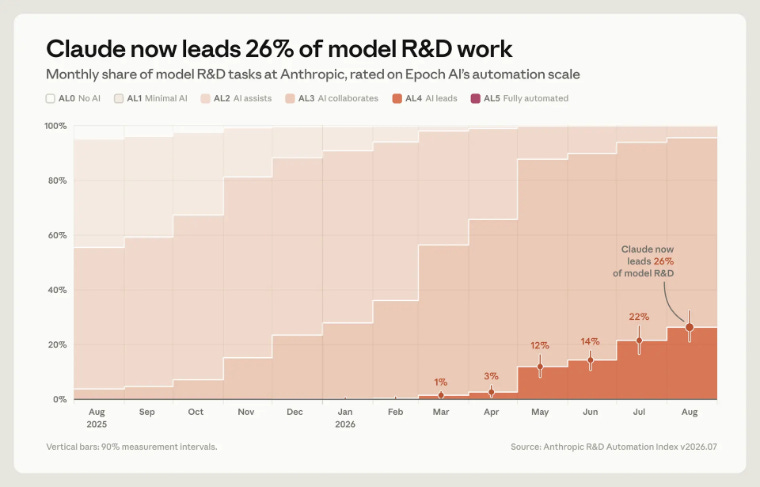
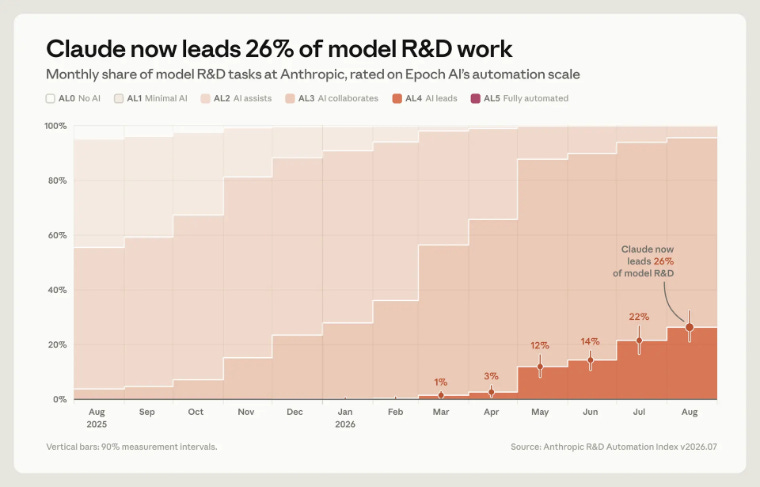
Anthropic’s data showing that Claude is “leading” an increasing share of AI R&D work:
EdgeBench suggests that “in-context learning ability has been doubling every 3 months, suggesting possibly explosive capability growth across many domains”
GPT-6 Astra represents a step-function change in model capability for interactive reasoning problems. It scores 66% on ARC-AGI-3 using our standard harness, and nearly 100% with a continuous conversation harness and custom compaction, at a cost of roughly $360 per game.
In fact, the continuous harness version significantly outperforms our human baseline in action efficiency across almost all levels. When we examined the reasoning chains to understand how the model operates, we found it performing highly efficient, on-the-fly symbolic world modeling for each game and level. It goes as far as developing its own shorthand DSL to represent in-game situations -- essentially a game-specific algebraic notation.Jakub Pachocki (Chief Scientist at OpenAI):
For many of us that have previously worked in mathematics and adjacent fields, seeing the resolutions to questions we’ve long thought about coming out of the model one after another in a single Slack thread felt deeply surreal. Having experienced that allows us to extrapolate—such a sudden transformation is plausible in deep learning research too. While this field relies more on experimentation, there is a long history of simple insights being missed for years; and so as soon as 2027 we could conceivably see a similar avalanche of fundamental pretraining advancements.
As often noted, the cost for a given level of AI capability plummets each year. Noam Brown predicts that a year from now, “solve the Navier-Stokes problem” will be available to everyone.
Other thoughts
Roon:
yes we can neither conclude nor rule out an intelligence explosion from [the METR report of 2x progress at Anthropic] IMO
the real tell will be when models’ research taste exceeds the research taste of good researchers if there is a constant or increasing slope. i would certainly expect it to be higher multiple than this 2x
Tom Reed notes that it would be very helpful to know whether “the main mechanism by which AI labour is contributing to the 2x acceleration of capabilities on well-specified tasks” comes from developing better learning algorithms, or more prosaic tasks.
Now a large proportion of the AI safety community is implicitly or explicitly orienting to futures where an intelligence explosion occurs within a few years. My default expectation (absent an extensive pause) is that a similar thing will happen: they’ll turn out to be directionally correct (relative to the expectations of almost anyone not linked to the community) but factually wrong. Specifically, we won’t have superintelligence within the next 8 years, but things will still be moving so fast that it’ll feel like the people who argued for short timelines were right.
Lots of people have been waiting for AI to make new discoveries by connecting ideas spread across different academic siloes. And (it sounds like) this is now happening in math. So why not outside of math? Some possibilities:
1. We’re not asking right: other fields don’t pose as many big open questions
2. Existing empirical results are too unreliable
3. Theoretical results outside of math are approximations to reality, and chaining together approximate results doesn’t work well
4. Verification of novel combinations outside math takes longer and is expensive
5. Ideas from one silo are not that applicable to ideas in another
6. It’s imminent, just be patientFriday’s news cycle really was almost too perfect to believe.
For months, I (and so many others) have been pointing to this notable divergence between accelerating model capability growth and slowing AI spending/rising data center costs.
You really cannot get a cleaner example of the principle that “AI capabilities ≠ real-world AI consequences” than getting news of a proof of the Riemann Hypothesis—which people have for years cited as a sign of takeoff, AGI, the beginning of the productivity boom that takes us into the transhumanist Valhalla, etc etc—at the same time that the Nasdaq absolutely vomits up all over itself as the AI Trade dies.Another parallel thing would be to get data on whether Dwarkesh’s mechanism is showing up empirically in AI research today and to what extent, to set timelines. Unfortunately the relevant data are hidden and writing in this area is as a result too vague. To wit, I would like to fit something like Chinchilla scaling laws to the closed labs models, and see how these are changing over time, but I can’t, because I don’t know key quantities like parameter counts, pretraining compute volume, and pretraining loss (and couldn’t normalize between the various labs’ pretraining datasets).
Further reading
Independent Assessment of AI R&D Acceleration at Anthropic in October 2026 – the recent METR report
How Close is Recursive Self-Improvement? A Review of the Evidence
Twitter post describing recent research by the Forecasting Research Institute
(With apologies to the authors of many, many excellent sources not mentioned here)